

MRFN (Retrograde Femoral Nail) System: The Comprehensive Guide
The MRFN System is an advanced intramedullary solution specifically engineered for fractures of the distal third of the femur. Unlike antegrade nails, the MRFN is inserted via the intercondylar notch (the knee), making it the superior choice for supracondylar fractures where hip-entry is either contraindicated or mechanically disadvantaged.
1. Core Implant Components
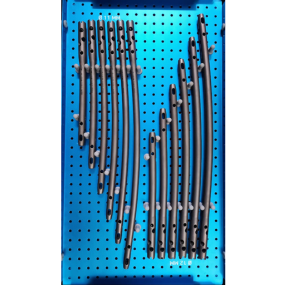
The MRFN Retrograde Nail
-
Anatomical Design: Features a specific distal bend and anterior-posterior curvature to match the natural anatomy of the femur.
-
Multi-Planar Distal Locking: The distal end (the part near the knee) contains multiple locking holes oriented in different directions. This “multi-planar” approach ensures rigid fixation of short distal fragments, preventing “windshield wiper” movement.
-
Universal Fit: Most MRFN nails are designed to be “Universal” (fitting both left and right femurs), reducing inventory requirements for hospitals.
-
Dimensions: Available in diameters from 9.5 mm to 12.0 mm and lengths ranging from 180 mm (short) to 400 mm (long).
Advanced Locking Mechanisms
-
5.0 mm Locking Screws: Heavy-duty screws provide the main anchorage. Some systems offer “threaded” holes in the nail itself to prevent screw back-out.
-
Distal End Caps: These are critical in retrograde nailing. They prevent bony ingrowth into the nail’s driving end, making future removal easier, and can provide additional angular stability to the most distal screw.
-
Spiral Blade Option: Some MRFN sets allow for a spiral blade instead of a standard screw in cases of severe osteoporosis, offering a larger surface area for bone purchase.
2. The Precision Instrument Set
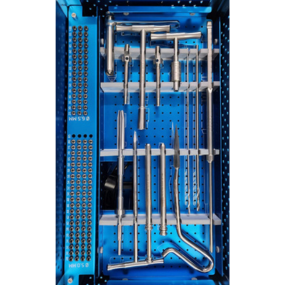
A high-quality MRFN set is defined by its instrumentation, which is designed to minimize fluoroscopy (X-ray) time:
-
Retrograde Insertion Handle: Ergonomically designed to provide tactile feedback while driving the nail through the distal femur.
-
Radiolucent Aiming Device: A specialized jig that allows the surgeon to lock the distal screws accurately without the insertion handle blocking the X-ray view.
-
Cannulated Reamers: Used to prepare the medullary canal. They are flexible to follow the natural curve of the femur.
-
K-Wires & Trocar System: For precise “entry point” location in the intercondylar notch, ensuring the nail is centered perfectly.
-
Extraction Bolt: Specifically designed for easy removal of the nail if the patient requires it years later.
3. Clinical Indications & Advantages
-
Supracondylar Fractures: Excellent for fractures near the knee joint.
-
Periprosthetic Fractures: The go-to solution for fractures occurring above a Total Knee Replacement (TKR).
-
Obese Patients: Easier entry point access compared to the hip (antegrade) approach in morbidly obese patients.
-
Polytrauma: Allows for surgery without the need for a specialized “fracture table,” saving critical time in emergency rooms.