
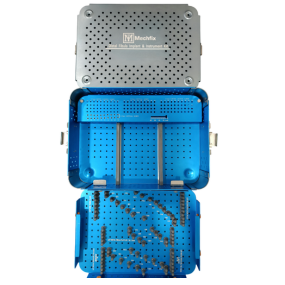
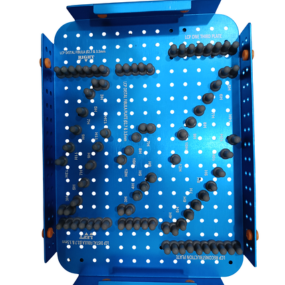
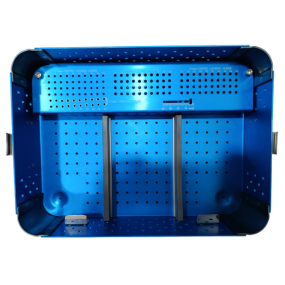
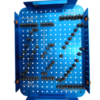
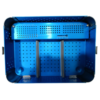

The Distal Fibula Instrument Set is a specialized orthopedic collection engineered for the precision treatment of lateral malleolus fractures and syndesmotic injuries. Because the fibula is a narrow, subcutaneous bone, this set is scaled down for high-accuracy work, ensuring that hardware provides maximum stability without causing soft-tissue irritation or “prominence” post-surgery.
Manufactured from 316L Surgical-Grade Stainless Steel (or medical-grade Titanium upon request), these instruments are designed to interface perfectly with 2.7mm and 3.5mm locking and non-locking plating systems.
Detailed Instrument Breakdown & Surgical Utility
1. Reduction and Manipulation Tools
-
Pointed Reduction Forceps (Mini): These allow the surgeon to “percutaneously” or directly grasp small bone fragments. The sharp tips minimize periosteal stripping, preserving the blood supply to the distal fibula.
-
Serrated Bone Holding Forceps: Designed with a more aggressive grip to maintain the anatomical length and rotation of the fibula against the pull of the lateral ligaments during plate positioning.
-
Periosteal Elevators (Round/Flat): Small-head elevators (typically 3mm to 6mm) allow for the gentle reflection of soft tissue from the lateral malleolus without damaging the thin skin envelope of the ankle.
2. Drilling and Alignment Systems
-
Universal Drill Guides (2.7mm / 3.5mm): These double-ended guides allow for both neutral (centered) and load (eccentric) drilling. This is critical for applying “compression” across a simple fracture line (the “Lag Screw” technique).
-
Threaded Drill Sleeves: Used specifically with locking plates to ensure the drill bit enters at a perfect 90-degree angle to the plate, ensuring the locking screw head threads correctly into the plate hole.
-
Calibration Drill Bits: High-speed, stainless steel bits with etched depth markings to provide the surgeon with an immediate visual cue of the bone’s width.
3. Measurement and Fixation
-
Mini Depth Gauge: Unlike large fragment gauges, this is calibrated for the thin cortical walls of the fibula (up to 50mm-60mm). It features a slim hook to ensure it catches the “far cortex” accurately for flush screw seating.
-
Star/Hexagonal Screwdrivers: Equipped with self-holding sleeves to prevent the loss of small 2.7mm or 3.5mm screws within the surgical site.
-
Syndesmotic Measurement Tool: Some sets include a dedicated gauge to measure the distance across the tibiofibular syndesmosis, ensuring the correct length for “syndesmotic screws” (Position Screws) used in high-ankle sprains.
4. Plate Contouring
-
Handheld Bending Irons/Pliers: While many distal fibula plates are pre-contoured, individual patient anatomy varies. These tools allow for “cold-bending” of the plate to match the specific flare of the lateral malleolus without compromising the strength of the metal.
Clinical Indications
-
Weber A, B, and C Fractures: The standard classification for ankle fractures involving the lateral malleolus.
-
Pilon Fractures (Fibula Component): Stabilizing the fibula to help restore the overall length of the leg before addressing the tibia.
-
Syndesmotic Disruptions: Stabilizing the “High Ankle” joint when the ligaments between the tibia and fibula are torn.
-
Malunion Corrections: Revision surgery to realign a fibula that healed in a shortened or rotated position.
Why This Set is Essential for Your Catalog
| Feature | Surgical Benefit |
| Low-Profile Scalability | Prevents patient discomfort and “hardware prominence” under the thin ankle skin. |
| Modular Tray Design | Perforated aluminum/stainless steel tray ensures 100% steam penetration during sterilization. |
| Matte Satin Finish | Reduces “OR Glare” from overhead surgical lights and loupes. |
| High Torque Tolerance | Instruments won’t bend or snap when driving screws into dense cortical bone. |